Get a clear view of today’s frontline labor market. Explore our data on job demand, candidate supply, wages, and work preferences, so you can stay ahead of workforce shifts and compete more effectively for essential talent.
ExploreThe frontline labor market continues to show strong demand, though growth looks very different when excluding the volatility of the trucking sector. Recently, non-trucking frontline job postings reached 3,995,432, a 1% increase from the previous reporting period and a striking 33% increase year-over-year.
While trucking remains a critical industry, its rapid swings in job postings – many of which remain unfilled – create outlier data that masks underlying trends in other frontline sectors. For this reason, our current aggregate job posting analyses exclude trucking. However, all data explorer tables still include trucking.
Candidate supply continues to lag behind demand in industries such as allied healthcare, caregiving, retail, and customer service, putting ongoing pressure on employers to compete for frontline talent.
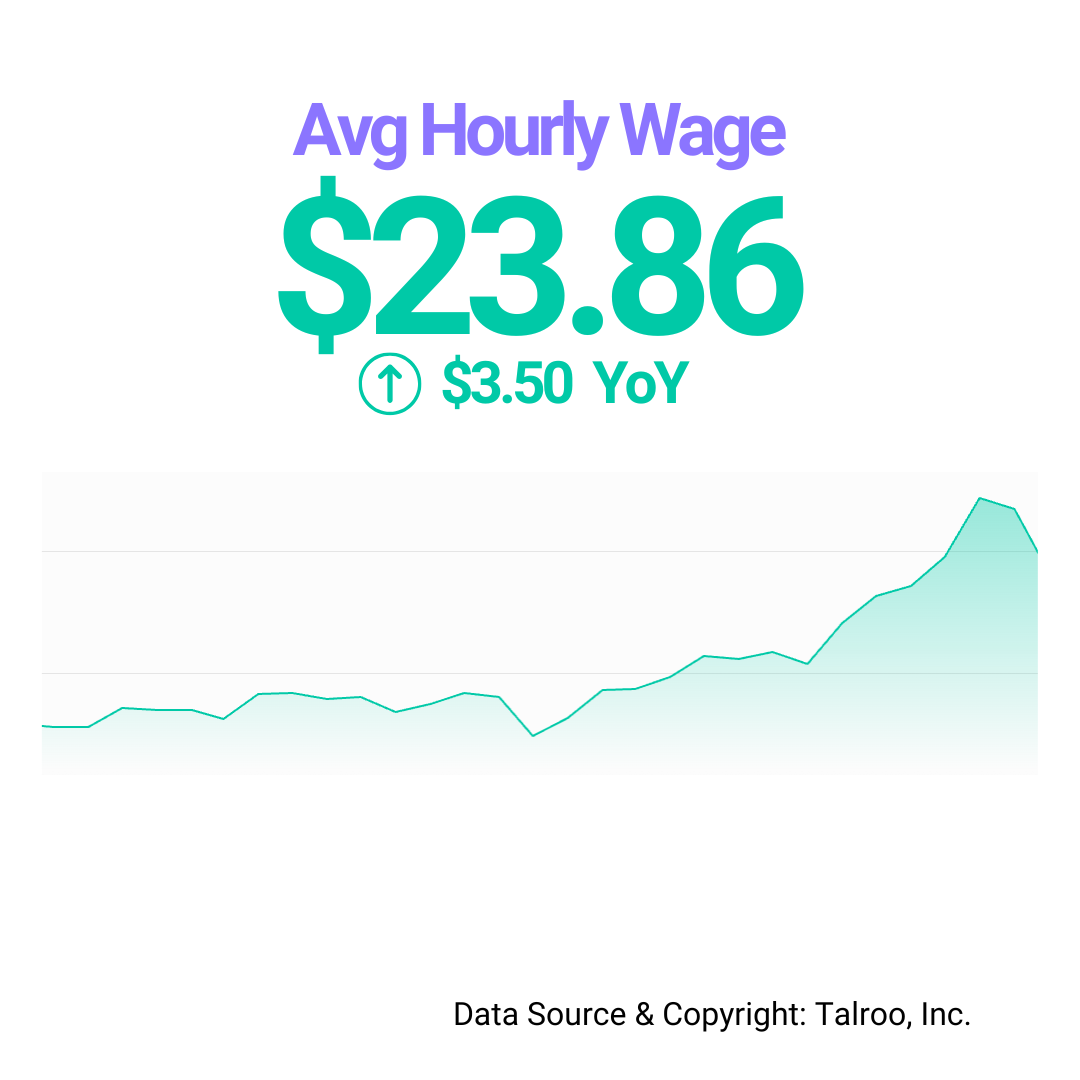
Employers are responding with higher pay and bonuses. Average hourly wages stabilized at $23.86, and average bonuses climbed to $6,251 (while there remained wide variations by industry), reflecting strong incentives to attract and retain talent in high-demand roles.
Key Trends:
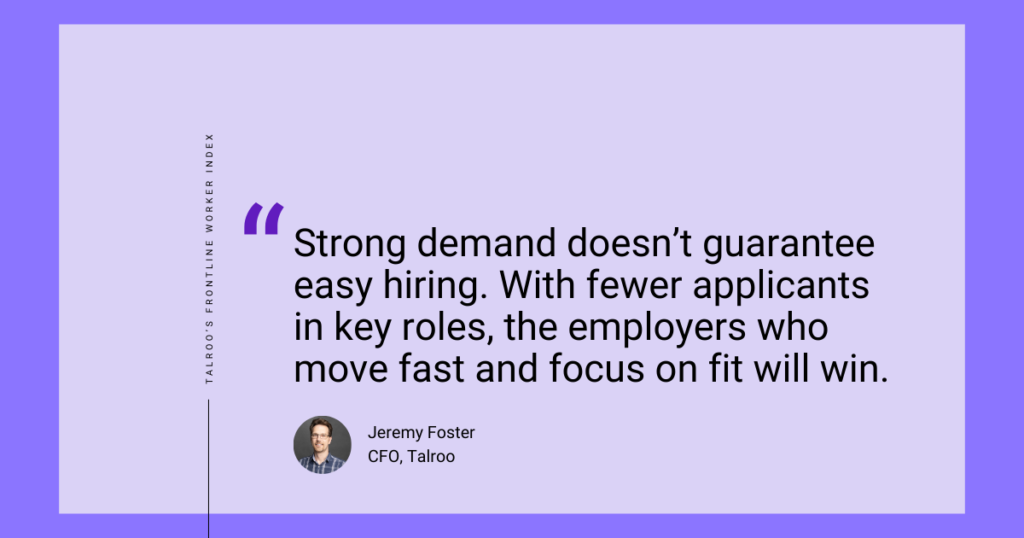
Frontline employers are navigating a market defined by opportunity and urgency. With wages climbing and demand strong, attracting the right talent has never been more critical – or more competitive.
Based on 2025 Q2 data.
To explore Talroo’s data and search findings for recruiting and hiring, use the Industry Explorer below. You can view nationwide trends or focus on specific states. Additionally, you can narrow your search by selecting industries or specific job titles. Happy searching!
According to Talroo’s analysis:

The Frontline Worker Index (FWI) provides valuable data on key factors like supply and demand, job titles, wages, work schedules, education and experience requirements, and the benefits frontline workers value most. By analyzing these insights, HR professionals and recruiters can develop more effective strategies for attracting, hiring, and retaining top talent in today’s highly competitive job market.
The FWI compares new resumes and new job posts to show the balance between job seeker supply and employer demand. Important Note: In our latest dataset, the trucking industry presents a statistical outlier; exploring the data by industry will give more actionable data.
As tracked by Talroo’s Frontline Worker Index, featuring proprietary first party data in addition to Public Insight Data, the following industries had the largest mismatch between job demand and candidate supply:
This dataset shows the average wage and sign-on bonus for jobs listed on the Talroo Ad Platform, and reflects significant regional discrepancies in states like California and New York. These states with strict salary transparency laws may skew the average wage data. In contrast, states with fewer transparency requirements remain underrepresented.
Six of the top ten frontline industries continue to outpace national average compensation growth. Notably:
“Wages are rising faster than the national average in 6 of the top 10 frontline industries, reflecting intense employer competition for talent in high-demand sectors.”
This dataset shows the indexed Work from Home, Part-Time, and Full-Time positions listed by clients on the Talroo Ad Platform. It’s important to note that some positions may be listed as part-time or full-time based on availability or store needs, but this doesn’t necessarily affect the overall numbers.
Our data highlights ongoing trends in employment structure and flexibility:
“Frontline organizations are doubling down on full-time roles – while remote work remains rare, reflecting the on-site nature of essential work.”
This index tracks Talroo clients who post jobs that do not require formal education or previous work experience. For example, roles such as warehouse workers or food service employees often fall into this category.
Explore the graphs below to see how these requirements vary by state or industry:
Our data indicates continued movement toward inclusive hiring practices:
“Employers are wisely opening doors by emphasizing skills over degrees and experience, expanding access to frontline opportunities.”
Data Source & Copyright: Talroo, Inc.
The Frontline Worker Index (FWI) is a comprehensive tool designed to provide insights into the labor market dynamics for frontline and essential workers exclusively. This report analyzes trends in supply and demand, job titles, wages, work schedules, education and experience requirements, and valued benefits. By examining these critical metrics, HR professionals and recruiters can develop effective strategies to attract, hire, and retain top talent in a competitive job market.Talroo processes an average of 26 million job posts every month, with over 187 million data points adding to this index directly. This extensive dataset is sourced first-party directly from Talroo, reflecting a broad spectrum of industries and geographic locations. Some job posts are comprehensive while others are less detailed; our goal is to encourage companies to be more transparent and intentional with their job posts to improve data quality and utility.The FWI reflects information from a wide range of sectors, powered by Talroo’s robust dataset and supplemented with Public Insight Data. The report includes detailed graphs and data points, offering a clear view of how different industries are managing tight labor markets and legislative changes for frontline roles. It’s important to note that our data does not reflect all positions equally; some job posts may represent a need for one hire, while others might represent a need for 1,000.Index numbers are based on January 2022, a point of relative stability in a post-pandemic world for frontline workers.This set of indices is an invaluable resource for HR professionals, recruiters, business leaders, and investors seeking to understand and navigate the complex landscape of frontline and essential workforces. It provides actionable insights that can help benchmark past and current performance, as well as forecast near-term industry trends and outlook.